
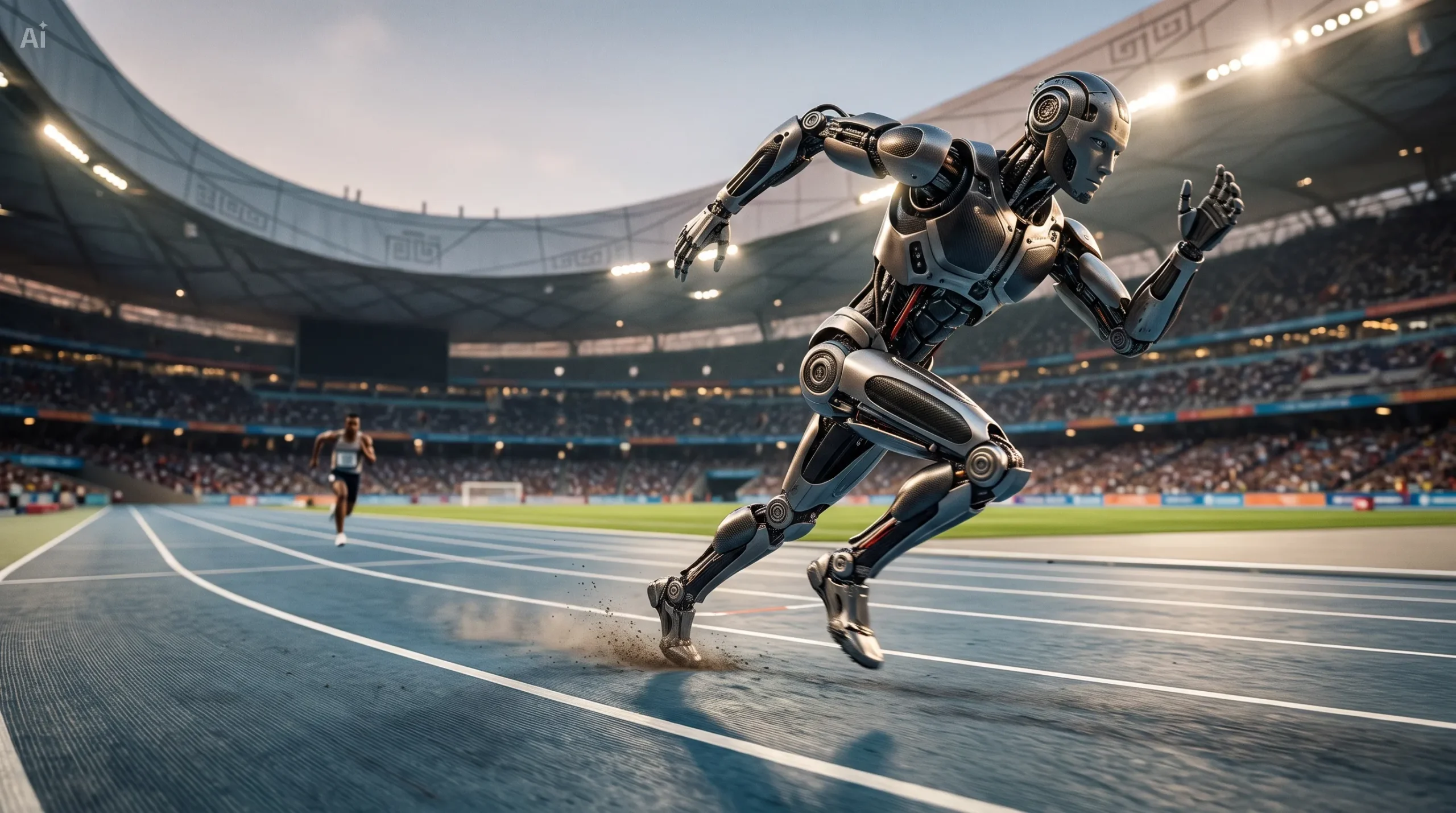
Chinese Humanoid Robot Beats Usain Bolt’s Record
But Its Biggest Test Is Still Ahead
Chinese Robots Have Entered a New Race
Usain Bolt’s 100-meter world record of 9.58 seconds has stood since 2009.
Now a humanoid robot has gone faster.
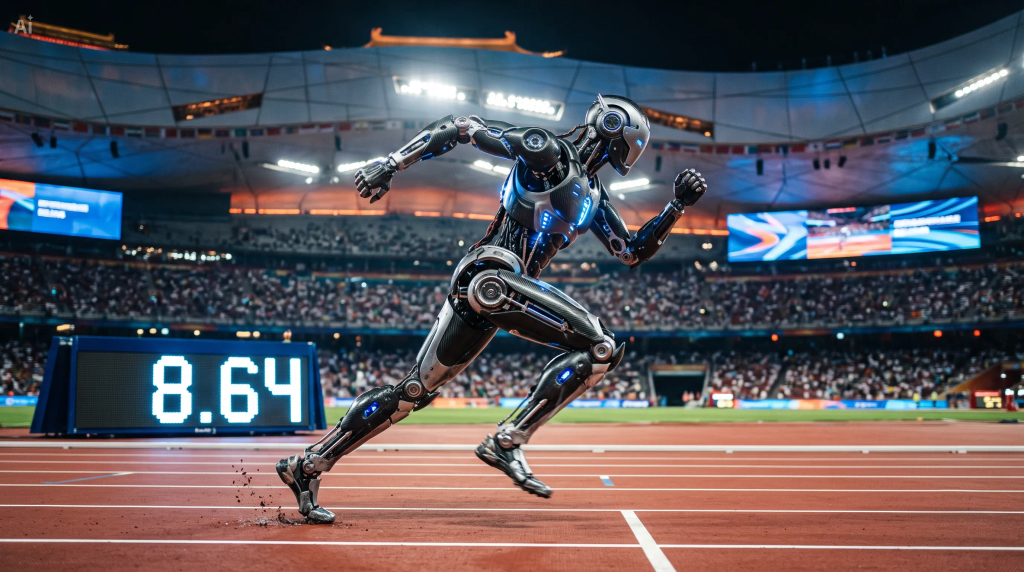
At the 2026 World Humanoid Robot Games in Beijing, China’s Tiangong Ultra completed the 100-meter sprint in 8.64 seconds, beating Bolt’s human record by almost one second.
The achievement sounds like something from a science-fiction movie. But the more interesting story isn’t simply that a robot can run faster than the world’s fastest human.
The real question is this:
What happens when humanoid robots become good enough to leave the stadium and enter the real world?
That may be the most important lesson from China’s latest Robot Olympics.
The Robot That Beat Bolt
Tiangong Ultra, developed in China, produced the headline-making performance at the second World Humanoid Robot Games.
Its 8.64-second run was considerably faster than Bolt’s 9.58-second human world record. The robot’s achievement also represented a major improvement over the previous year’s humanoid robot competitions.
But there is an important distinction.
A robot beating a human’s running time does not mean robots have suddenly become better athletes in every sense.
Humans and machines have very different physical characteristics.
A humanoid robot does not experience fatigue in exactly the same way as a human athlete. Electric motors can deliver consistent power, while software can precisely control movement and optimize every step.
Reuters reported that Tiangong Ultra used more than 50 steps during its sprint, compared with Bolt’s roughly 41 steps. The robot also started from an upright position rather than using the explosive starting technique of a human sprinter.
And then came another reminder of the gap between speed and intelligence.
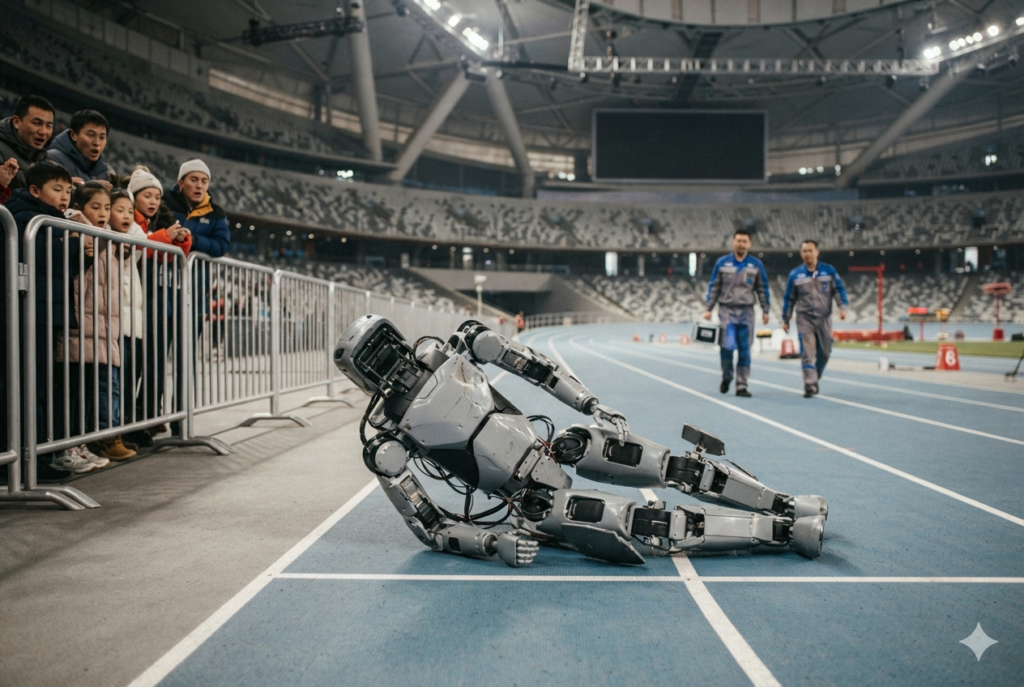
After completing the race, the robot crashed into a wall.
That moment may have been almost as important as the record itself.
Faster Than Humans Doesn’t Mean Smarter Than Humans
This is where the Robot Olympics becomes much more interesting.
A human athlete does not simply run in a straight line.
We constantly adjust our bodies to changing conditions. We recognize obstacles, react to unexpected movement, maintain balance and make decisions without consciously calculating every movement.
Robots are still working toward that level of flexibility.
The Beijing competition demonstrated both sides of the story.
Some humanoids showed impressive speed, strength and coordination. Others fell, collided with barriers, lost components or struggled with relatively ordinary tasks.
The contrast is striking:
A robot can beat Usain Bolt’s 100-meter record and still struggle with some things that a human child can do naturally.
That tells us something important about the future of robotics.
The hardest problem may not be making robots stronger or faster.
It may be making them reliable.
China’s Robot Olympics Was About More Than Running
The 2026 World Humanoid Robot Games were not simply a collection of robot races.
The competition included sports such as sprinting, football, table tennis, boxing, jumping and weightlifting.
But organizers also included something more important: real-world scenarios.
The event featured tasks related to areas such as housekeeping, firefighting and retail assistance. Beijing’s government had described the competition as containing both competitive sporting events and scenario-based challenges.
That distinction matters.
Running 100 meters in 8.64 seconds is spectacular.
But imagine a robot that can safely:
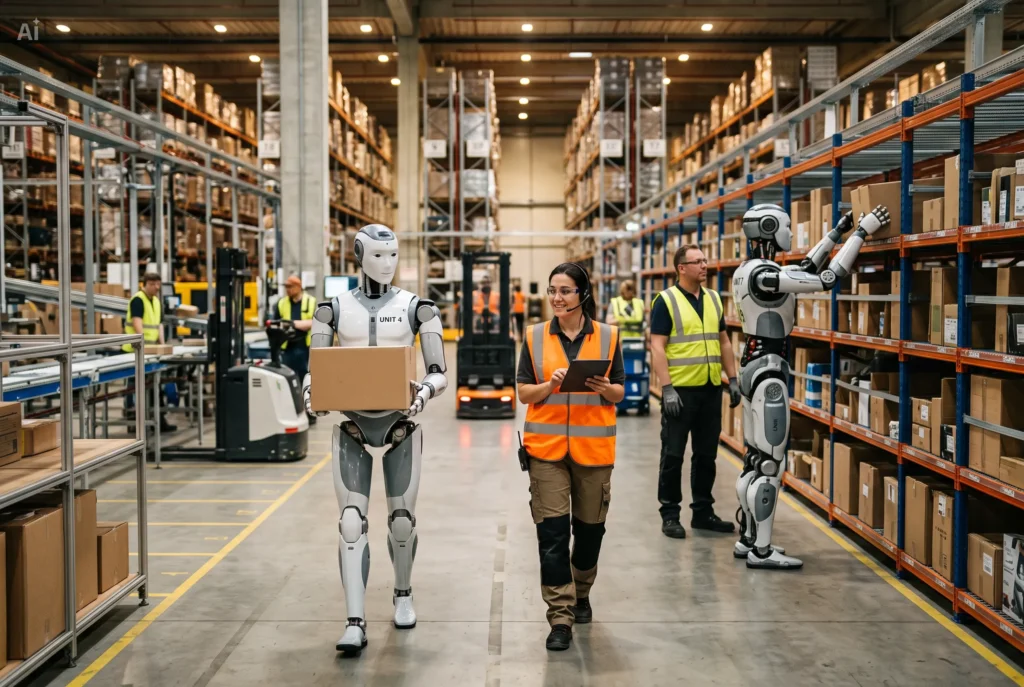
- carry boxes through a warehouse
- organize products on shelves
- assist elderly people
- clean a hotel room
- respond to emergencies
- operate machinery
- work alongside humans in factories
- perform repetitive tasks for hours
Those capabilities could have a much bigger economic impact than winning a robot race.
The Real Competition May Be for Jobs
This is perhaps the most important reason to pay attention to humanoid robots.
Factories have used industrial robots for decades. But traditional industrial robots are usually designed for specific tasks in controlled environments.
Humanoids are different.
Their human-like shape is intended to allow them to operate in environments already designed for people.
Doors, stairs, tools, shelves, workstations and vehicles were largely built around the human body.
If a robot can eventually move through these environments safely and intelligently, companies may not need to redesign entire workplaces.
That creates enormous commercial possibilities.
Imagine a warehouse where humanoid robots work alongside human employees.
Or a hotel where robots move laundry and supplies.
Or a factory where robots perform dangerous or physically exhausting tasks.
Or an emergency-response robot entering an unsafe building before human firefighters.
The technology is still developing, but these are the kinds of applications that could make humanoid robots commercially important.
Why China Is Taking Humanoid Robots So Seriously
China’s huge manufacturing ecosystem gives its robotics industry an unusual advantage.
Humanoid robots require far more than artificial intelligence.
They need:
- motors
- batteries
- sensors
- cameras
- processors
- actuators
- lightweight materials
- control systems
- precision manufacturing
China already has a massive industrial supply chain capable of producing many of these components at scale.
The Robot Olympics therefore serves another purpose: it gives companies an opportunity to demonstrate what their machines can do.
The 2026 event featured more than 2,000 humanoid robots, with participants from 16 countries, although Chinese teams made up the overwhelming majority of competitors.
That scale is significant.
China isn’t treating humanoid robots as a laboratory experiment that may become useful someday.
It is building an ecosystem around them.
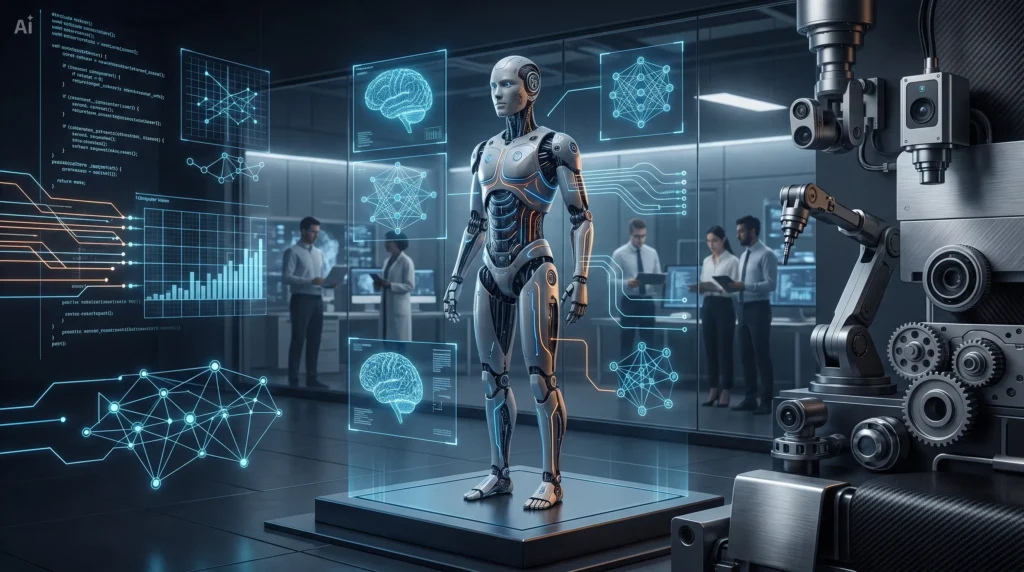
The AI Race Is Becoming Physical
For years, the artificial intelligence race was mainly about software.
Companies competed to build better language models, image generators, coding assistants and AI agents.
Humanoid robots change the equation.
Now AI has a body.
A large language model can generate an answer in seconds.
A humanoid robot must turn intelligence into physical action.
It has to understand where objects are, determine how to pick them up, maintain balance, avoid obstacles and react when something goes wrong.
That makes robotics one of the most difficult frontiers of AI.
The Beijing games offered a fascinating demonstration of this transition from digital AI to physical AI.
But Robots Still Have a Long Way to Go
It would be easy to look at an 8.64-second sprint and conclude that humanoid robots are almost ready to replace humans.
That would be a mistake.
The Beijing games showed significant limitations as well as impressive achievements.
Robots can be extremely good at a narrowly defined task.
But the real world is unpredictable.
A human can walk into a room, notice that something looks unusual and immediately change their plan.
A robot may need sensors, software and trained models to recognize the same situation.
Even apparently simple tasks can become difficult when objects move unexpectedly, lighting changes or something is slightly different from what the robot has seen before.
This is why the future of humanoid robotics won’t be decided by a single race.
It will be decided by reliability, autonomy, cost and usefulness.
The Most Important Robot May Not Be the Fastest One
The Tiangong Ultra’s sprint is undeniably impressive.
But imagine two robots.
Robot A runs 100 meters in 8.64 seconds but requires human intervention whenever something unexpected happens.
Robot B runs 100 meters in 15 seconds but can independently navigate a warehouse, identify objects, recover from mistakes and safely work beside humans for eight hours.
For a company, Robot B may be far more valuable.
That’s why the less glamorous competitions at the Robot Olympics may ultimately matter more than the headline-making sprint.
Tasks such as cleaning, sorting, carrying, firefighting and assisting people test something that running in a straight line cannot:
Can the machine actually function in the messy real world?
Are We Watching the Beginning of a New Robot Era?
The 2026 World Humanoid Robot Games may eventually be remembered for more than a few extraordinary race times.
The event demonstrated how quickly humanoid robotics is improving.
A machine running faster than Usain Bolt would have sounded impossible only a few years ago.
Today, it has happened.
But the more fascinating story is what comes next.
Can these robots become affordable?
Can they operate autonomously?
Can they safely work alongside humans?
Can they understand complicated environments?
Can they recover when something goes wrong?
And perhaps the biggest question:
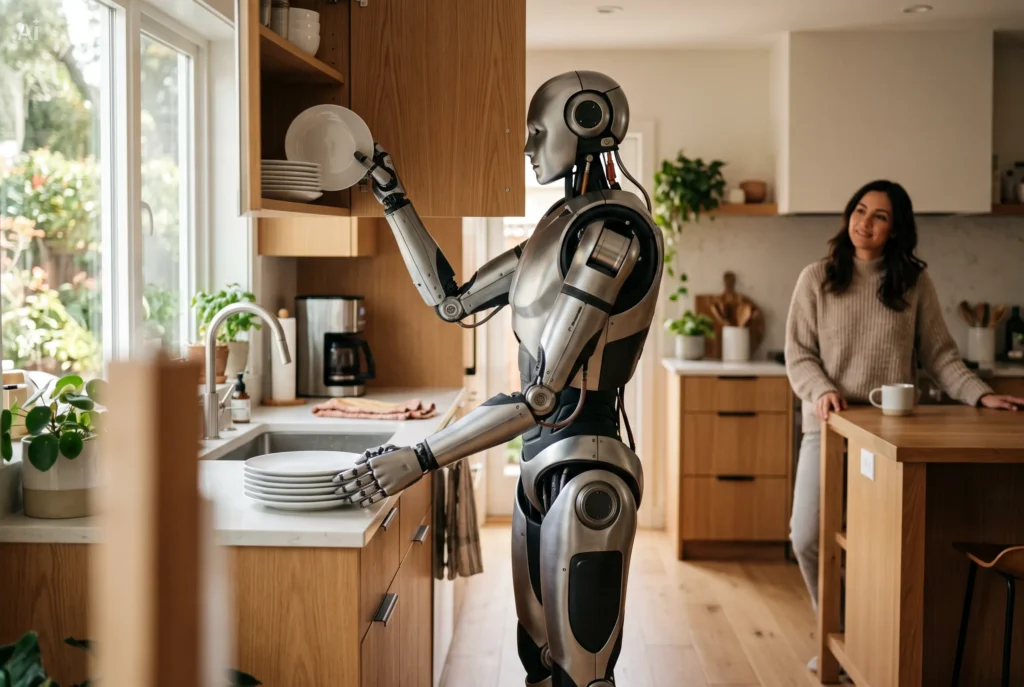
Can a humanoid robot become useful enough that ordinary people encounter one not at a technology demonstration, but at work, in a hospital, in a store or even at home?
China’s Robot Olympics suggests that the race has already begun.
The winner, however, may not be the robot that runs the fastest.
It may be the robot that can think, move, adapt and work reliably in the real world.
And that race is only getting started.
Final Takeaway
The most important lesson from Beijing isn’t that robots can now outrun humans.
It is that robotics is moving rapidly from controlled demonstrations toward real-world applications.
The 8.64-second sprint is a remarkable engineering achievement.
But the bigger revolution could happen quietly—in factories, warehouses, hospitals, hotels and homes.
The Robot Olympics gave us a glimpse of that future.
Now the real competition begins.